









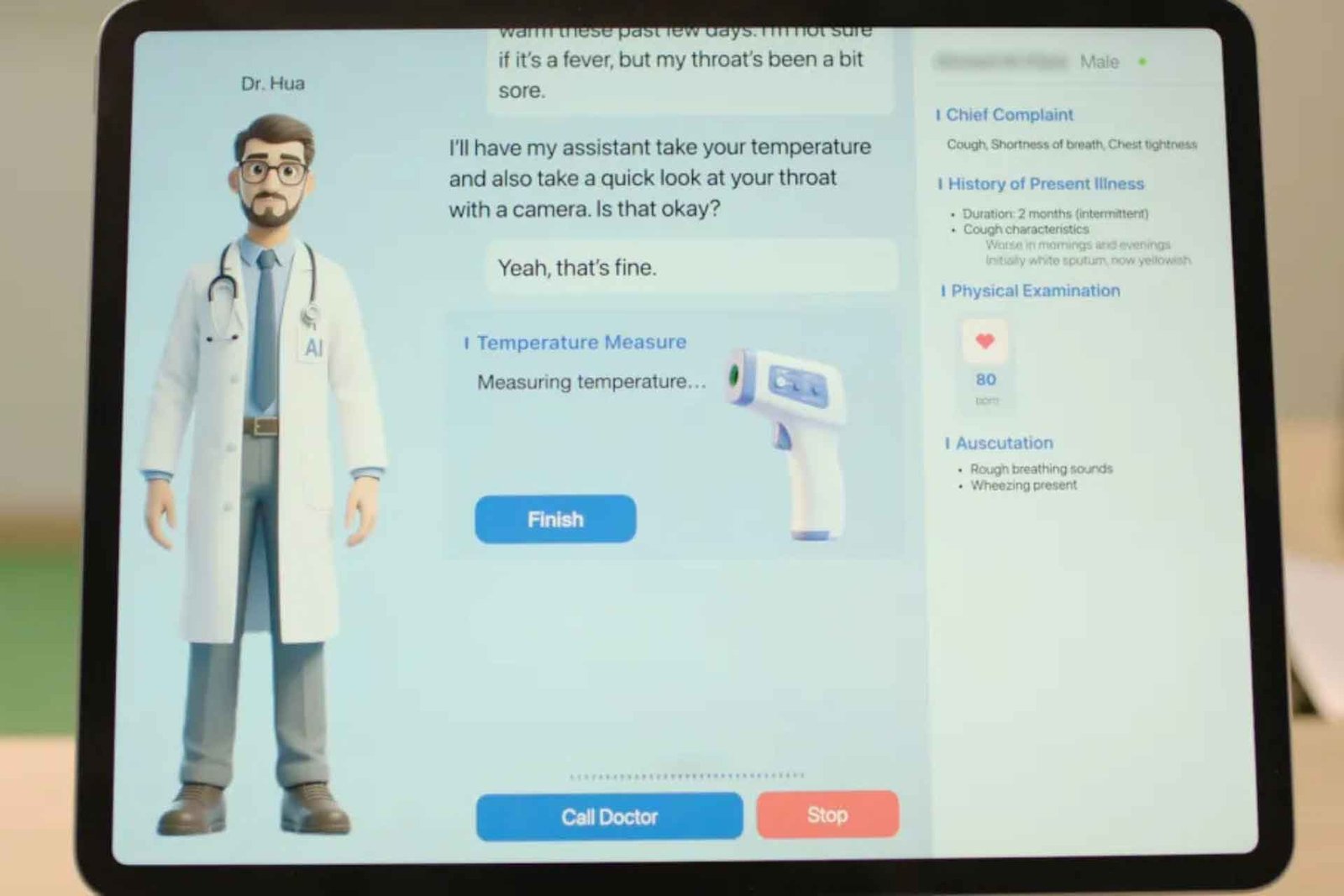


A Chinese startup has opened the world’s first clinic in Saudi Arabia where artificial intelligence diagnoses patients, a key step in replacing human doctors as the first line of medical treatment.
Synyi AI, a Shanghai-based medical technology company, launched the trial program in Saudi Arabia’s eastern Al-Ahsa region in April in collaboration with the country’s Almoosa Health Group. The pilot will see a virtual AI doctor making diagnoses and prescriptions to patients on its own, through interactions similar to dealing with a human doctor.
When patients come to the clinic, they describe their symptoms via a tablet computer to an AI “doctor” named “Dr. Hua”. The AI follows up with more questions and analyzes data and images taken with the help of human assistants, such as cardiograms and X-rays. Once the consultation is over, Dr. Hua provides a treatment plan, which is reviewed and signed off by a traditional human doctor without seeing the patients. The human doctors are also on hand to deal with emergencies that AI can’t handle.
The technology had an error rate of less than 0.3% during a testing phase prior to the current trial, according to Synyi AI.
“What AI has done in the past is to assist doctors, but now we are taking the final step of the journey to let AI diagnose and treat the patients directly,” Synyi AI CEO Zhang Shaodian said in an interview.
So far, a few dozen patients have used the service free-of-charge, with a human doctor in attendance because the project is still under trial. The pilot program is generating AI diagnostic data which will later be submitted to the Saudi authorities for approval before the service can become commercially available. Zhang says he is optimistic permission will be granted within 18 months.
Still, doubts remain among medical professionals that AI can adequately replace human doctors any time soon.
“We know of multiple attempts to build this kind of fairly capable AI doctors, to talk directly to patients, but even the best ones don’t even function at the level of a primary practitioner,” said Ngiam Kee Yuan, a senior consultant at Singapore’s National University Hospital. “I will be very skeptical.”
For now, Dr Hua’s services are limited to respiratory complaints, covering about 30 diseases, such as asthma and pharyngitis. The company plans to expand the list to cover 50 respiratory, gastroenterological, and dermatological diseases over the coming year. The company is also working with other hospitals in Saudi Arabia to open similar clinics in the next few months.
Synyi AI is just the latest in a number of Chinese health companies setting up in the Middle East as they refine their technology to make it suitable for global real-world application. Shanghai Fosun Pharmaceutical Group Co. signed a deal with Saudi Arabia’s Fakeeh Care Group earlier this year to advance cell and gene therapy and tele-diagnostics. XtalPi Holdings Ltd., a Chinese AI-backed drug-discovery company, is setting up a robotics lab in the United Arab Emirates.
AI has already been widely applied in online consultations by some of China’s leading Internet health-care services — but it still largely serves an auxiliary role. Several Chinese companies are developing AI tools similar to ChatGPT to conduct consultations independently, but none are in commercial use yet. Chinese online health-care provider Medlinker, for example, unveiled an AI doctor dubbed MedGPT, claiming it’s capable of diagnosing some of the most common diseases with the same degree of accuracy and consistency as a human doctor.
“Medical AI directly impacts people’s lives, so scrutiny is essential,” said Dylan Attard, co-founder and CEO of MedTech World, an event and media company focusing on medical technology. “Guardrails are needed to ensure safety, efficacy, and public trust. That said, regulators need to strike a balance, being thorough, but also adaptive enough not to stifle innovation.”
Founded in 2016, Synyi AI has been backed by Tencent, Hongshan Capital, GGV Capital and local government funding. It has worked with over 800 hospitals, clinics, and medical colleges in China to use AI to manage data, assist in diagnoses and perform research work. Saudi Arabia is the company’s first overseas market.
Zhang said the company is also in talks with local governments in China on similar projects, but first it needs to test whether the model is commercially viable in its home country, where publicly funded health care makes consultations inexpensive. In Saudi Arabia and many countries where seeing a doctor can be pricey, AI can help significantly reduce the costs. He also sees the benefits of AI being strongest in remote locations which often lack medical staff.
“I think it will increase the efficiency as much as tenfold,” he said.
Content Courtesy – Bloomberg